Red Lines, White Plates: What's Wrong With Cleveland's Culinary Hype
Some cities built food culture through inclusion. Cleveland drew lines. But the East Side still cooks with soul.
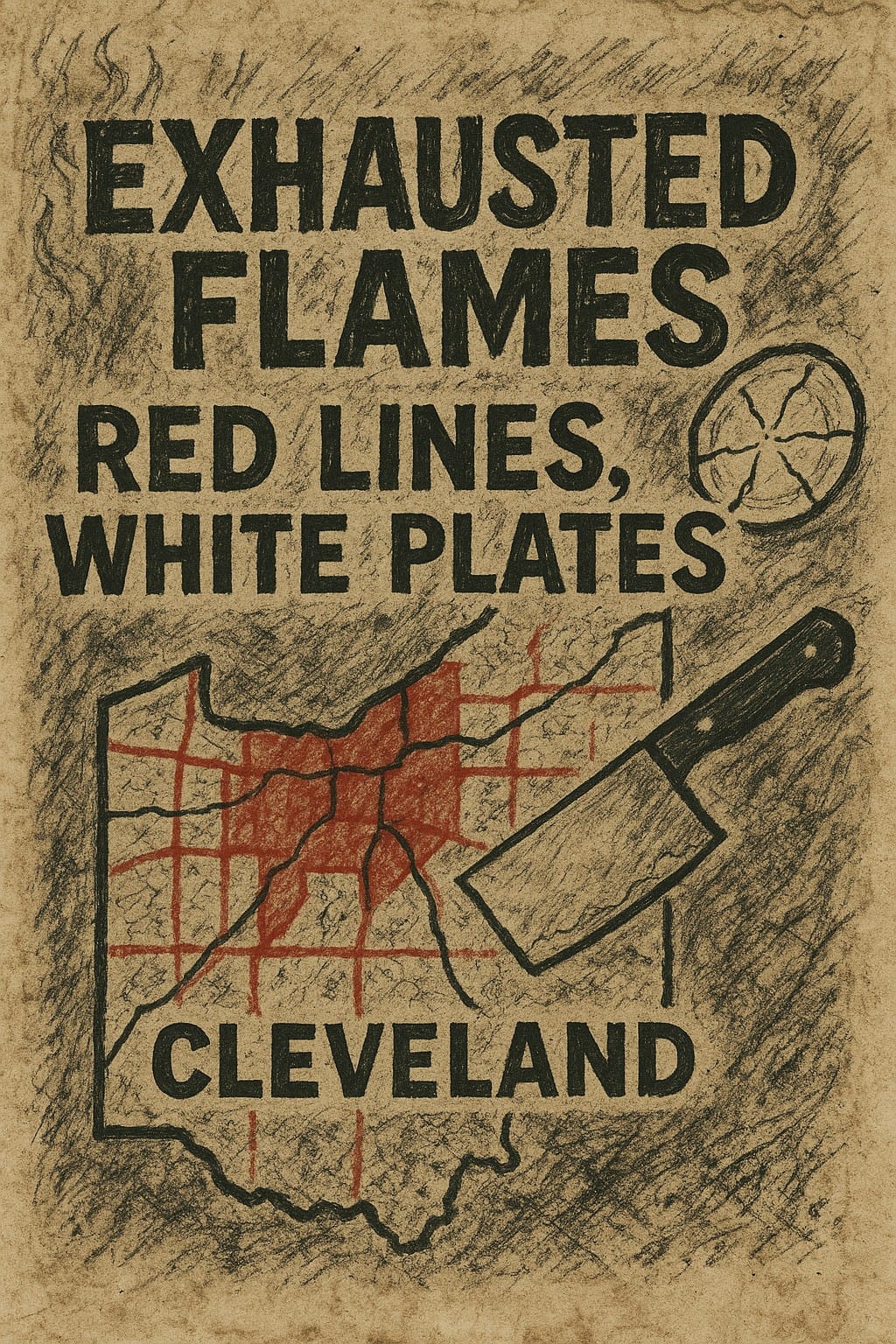
Exhausted Flames
The burners have cooled, the wok’s been rinsed and oiled, but the shift still simmers in the back of the mind.
Notes from a chef that rarely sleeps.
—
Red Lines, White Plates: What's Wrong With Cleveland's Culinary Hype
In the 1930s, federal maps didn’t just mark streets—they carved up Cleveland’s future. Entire neighborhoods—Black, immigrant, working-class—were outlined in red and labeled “hazardous” for investment. Banks followed suit, denying mortgages and business loans to anyone outside the white middle and upper class. Redlining didn’t just shape the housing market; it decided who got to build wealth and who was boxed out.
I grew up moving around Cleveland’s East Side—Collinwood, Euclid, Maple Heights, places people don’t bring up in glossy food write-ups. Not because there’s nothing there, but because of decisions made nearly a century ago. When the Fair Housing Act passed in 1968, the maps stopped being legal—but the damage was already done. White flight, disinvestment, and decades of corrupt city planning left deep scars. Today, those same lines still decide where grocery stores go. What side of town is beautified. And yeah, even where the food writers reside.
Cleveland didn’t just fall short of becoming a great food city—it was sabotaged from the start.
I own an Asian Fusion vegan restaurant on Cleveland’s East Side. And I’ve been told, again and again: “You should move west.”
To Lakewood. To Ohio City. To the land of curated small plates and “local concepts.” (You know the ones.)
But here’s the kicker—I don’t want to. I know it’s profitable to be there, and I don’t care.
I didn’t become a chef to follow the flavorless path of gentrified food trends. I cook in this city because the East Side raised me. AsiaTown fed and inspired me as a young vegan activist. I explored compassionate cooking techniques and found community in Cleveland’s international markets. If I head west today, I rarely make it past La Plaza—on the eastern edge of Lakewood.
I’m often written off as an opinionated vegan chef. And yeah, I am. But I’m also someone who knows something our food media seems to ignore: diversity—not branding, not capital, not marketing—is what makes a great food town. Coincidentally, it’s also something vegan and vegetarian diners understand deeply. Plant-based diets, more than most, are culturally diverse at their core.
That’s why cities like New York, Chicago, and Los Angeles thrive: diversity. That’s also why Cleveland’s food scene remains stuck.
Because we ignore the neighborhoods where food still comes from memory, not marketing.
When we undervalue Black and immigrant communities—when we treat diversity as a novelty instead of culinary creativity and craft—it shows.
In the menus.
In the media.
In the bland repetition of the same safe bets, dressed up for Instagram and backed by a restaurant group with three or more “concepts.”
Our food media parades the same restaurant groups, the same celebrities. Stuck on one side of the bridge, a lot of Clevelanders still fear that red line—drawn decades ago by bankers and bigots—and in doing so, miss out on the best food this city has to offer.
The East Side may not have the riches of the West, it may not be as trendy or young, but it has something else: culture.
The Cleveland Orchestra at Severance.
The Cultural Gardens.
Markets where five languages are spoken before you hit the back aisle.
Hands that know how to fold dumplings, make kimchi, and turn scraps into something scrumptious.
A food town protects its immigrant communities. It doesn’t push them east or out.
A food town doesn’t treat diversity like a liability.
A food town doesn’t choose restaurant groups in suits over chefs who actually work the line.
If Cleveland wants to be the food city it claims to be, it needs to show up for the cooks it overlooks—and the neighborhoods it avoids, consciously or not.